https://www.discovery-studios.com/
This is a weekly newsletter about how people and technology intersect. To receive Digital Native in your inbox each week, subscribe here:
Throughlines
There are a lot of words we hear again and again in 2021—metaverse, NFT, creator, Web3. Given the sheer pace of innovation, it’s become hard to keep up and easy to lose the forest for the trees. But the thing is, these words all connect: they interrelate and build on one another to forge a new digital future.
Six months ago, I wrote Chain Reactions to make sense of it all. I thought it was again time to step back and offer the 10,000-foot view of how the topics I write about in Digital Native intersect. And what better way to do so than through the lens of those buzzwords? In this piece, I’ll dive into 10 buzzwords:
-
Community
-
Authenticity
-
Avatars
-
Metaverse
-
VR & AR
-
Web3
-
Tokens (Fungible & Non-Fungible)
-
DeFi
-
DAOs
-
Creators
I’ll unpack each one and take a stab at connecting the dots. Let’s jump in.
🙏 Community
On her song “Coney Island”, Taylor Swift sings:
‘Cause we were like the mall before the internet
It was the one place to be
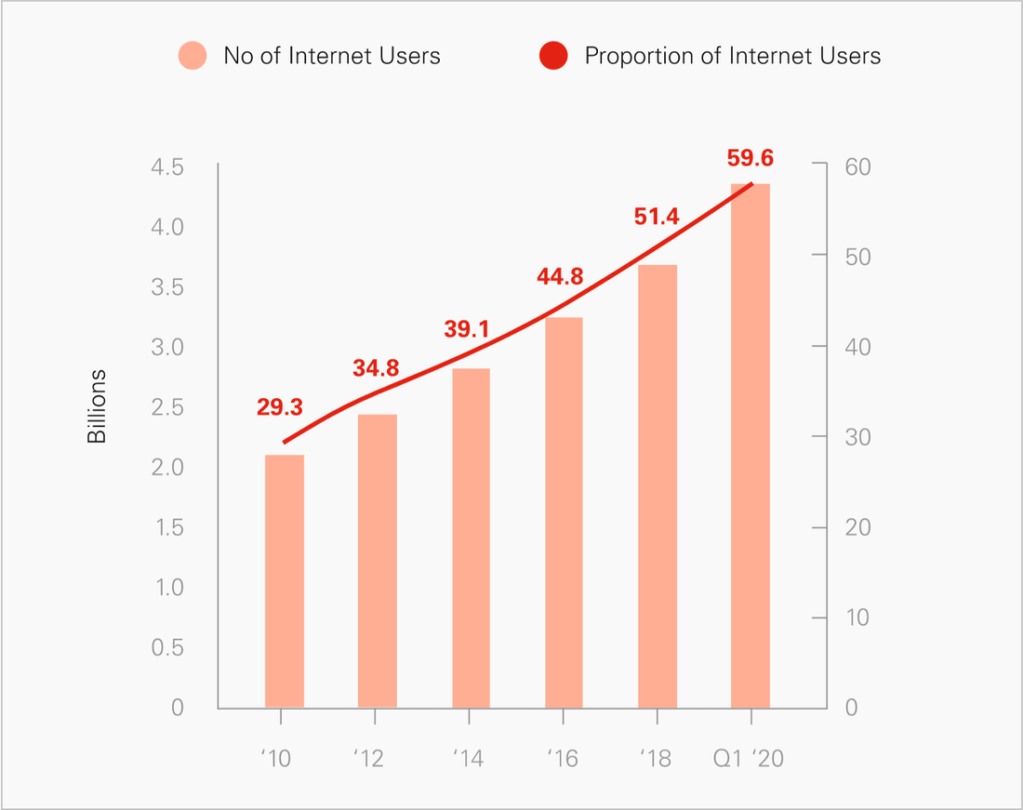
It’s a simple line that captures the longing for a bygone relationship. But it also, in my mind, captures how we’ve become a predominantly digital species. The internet is the new mall: 4.5 billion people are online—60% of the human race. The internet is where we seek and find community.
What’s fascinating is that today’s communities are both the deepest and the broadest in human history. During last month’s Index Creator Summit, Discord’s Jason Citron mentioned that Discord has 19 million (!) weekly active servers. That’s up +184% from 6.7 million a year ago. Each server is the living, breathing nucleus of a community. Jack Conte of Patreon framed it this way: you may think your interests are niche—maybe only 1 in 1,000 people like the same things as you—but with 4 billion people online, that’s 4 million people who share your interests. On the internet, no niche is too niche.
At the same time, the internet’s scale unlocks breadth: 142 million Netflix accounts watched Squid Game in its first month—67% of all accounts around the world. The pace of internet culture means cultural phenomena have shorter durations (there will be another hit show next month), but this scale has never been seen before.
Over the weekend, I came across this comment on TikTok:
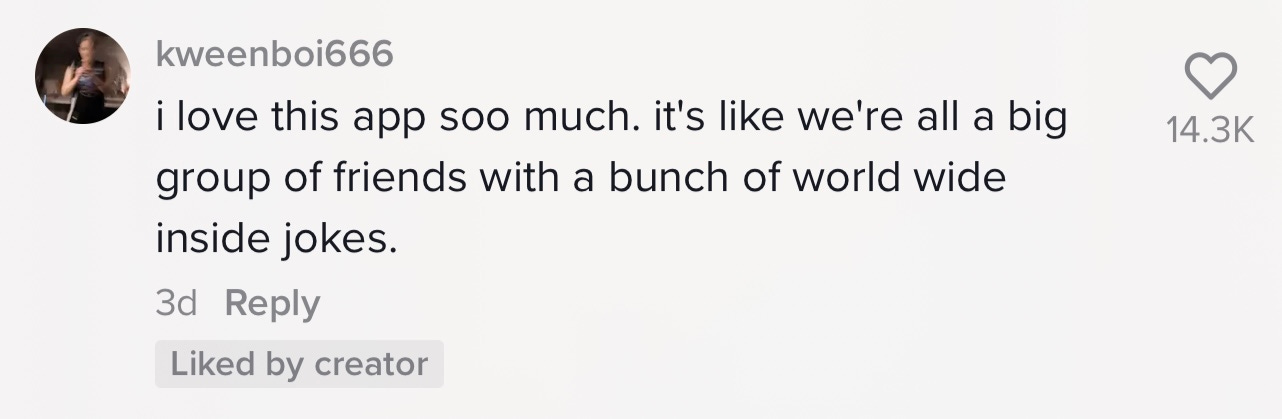
kweenboi666, whoever you are: you’re right. The sounds and challenges on TikTok are massive, collective jokes shared by millions of creators and a billion monthly active users. One week, it’s a cranberry juice-drinking, Fleetwood Mac-listening skateboarder; the next, we’re all debating “it’s giving cher” 💅; last month, we were all on couch guy TikTok. Lying in bed scrolling our FYP, we feel like we belong.
There are interesting companies building for online belonging: Geneva is a hub for all your community chats; Yoni Circle provides community for women through storytelling; Circle equips creators with the tools to manage their community.
Last week, Ian Bogost argued in The Atlantic that the internet actually lets us talk too much—that humans were never meant to talk and be heard to this extent. He writes:
A lot is wrong with the internet, but much of it boils down to this one problem: We are all constantly talking to one another. Take that in every sense. Before online tools, we talked less frequently, and with fewer people. The average person had a handful of conversations a day, and the biggest group she spoke in front of was maybe a wedding reception or a company meeting, a few hundred people at most.
He might be right, but the floodgates of online communication are open. Everyone now has a megaphone. Bogost argues that Facebook should be more like how Google+ was originally conceived, back in 2011: built for intimate, small-group relationships.
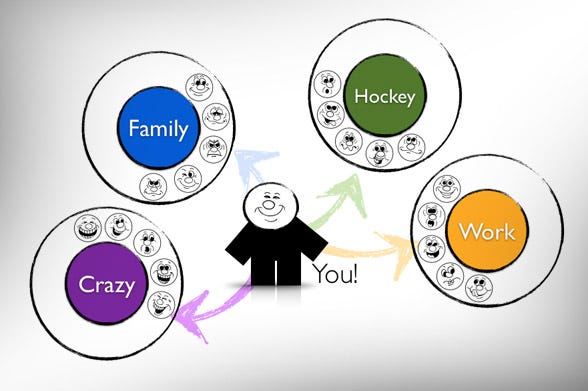
But what if Discord is the better version of Google+? Those 19 million Discord communities aren’t built for a 2011 social graph like Google+ was—your work friends, your hockey league—but for a 2021 social graph: your multinational Fortnite team, your fellow Nicki Minaj stans, and so on. Belonging is borderless.
In Digital Kinship last spring, I wrote about our loneliness epidemic—about how nearly half of Americans always or sometimes feel alone (46%) or left out (47%). The internet is both a cause of and an antidote to our loneliness epidemic. Soul, China’s 5th-most-popular social app, emphasized this duality in its S1 filing:
We have especially attracted young generations in China, who are native to mobile internet and who therefore more palpably experience the loneliness technologies bring.
As more of our lives go digital, we more deeply feel the gaps where rich, in-person interactions used to be. Yet technology is also a salve for that isolation, connecting us in new ways to new people. Soul’s filing mentions the word “community” 43 times.
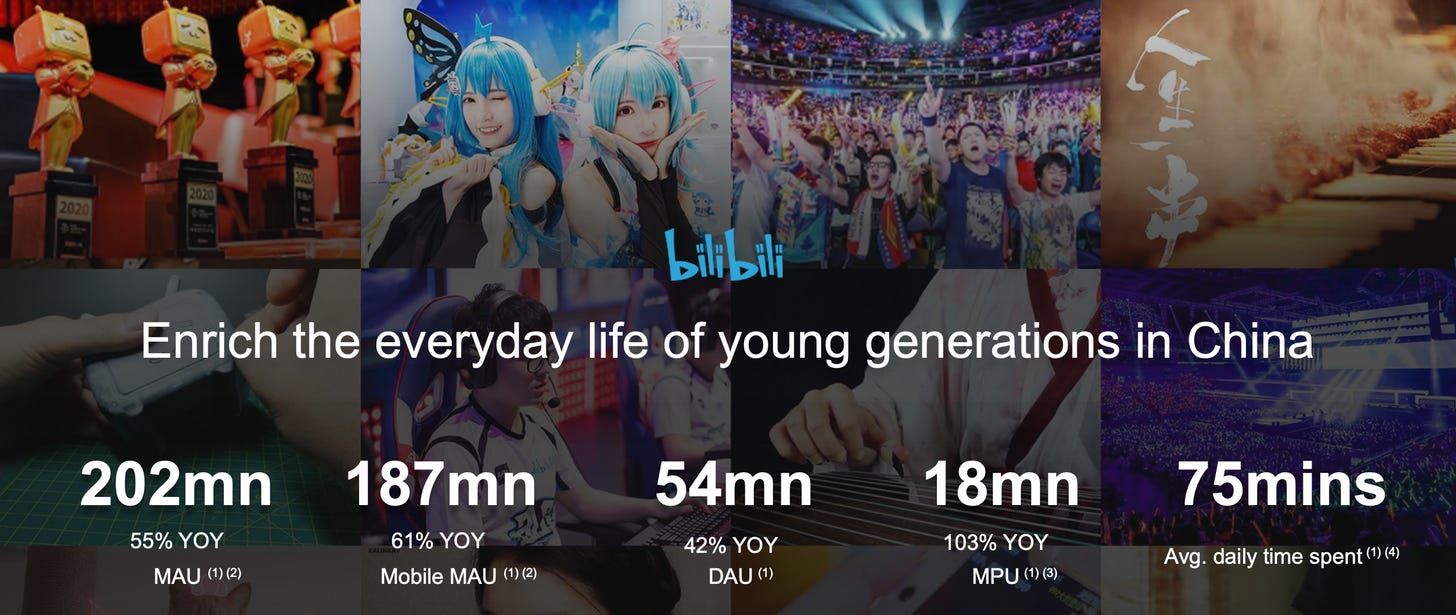
Another Chinese internet company, Bilibili, has grown to a $33 billion market cap by nurturing niche communities. Bilibili has 202 million monthly active users (putting it not far behind Snapchat) who are averaging 75 minutes of daily engagement (for reference, Instagram and TikTok are 53 minutes and 52 minutes, respectively).
a.image2.image-link.image2-615-728 {
display: inline;
padding-bottom: 84.47802197802197%;
padding-bottom: min(84.47802197802197%, 615px);
width: 100%;
height: 0;
}
a.image2.image-link.image2-615-728 img {
max-width: 728px;
max-height: 615px;
}
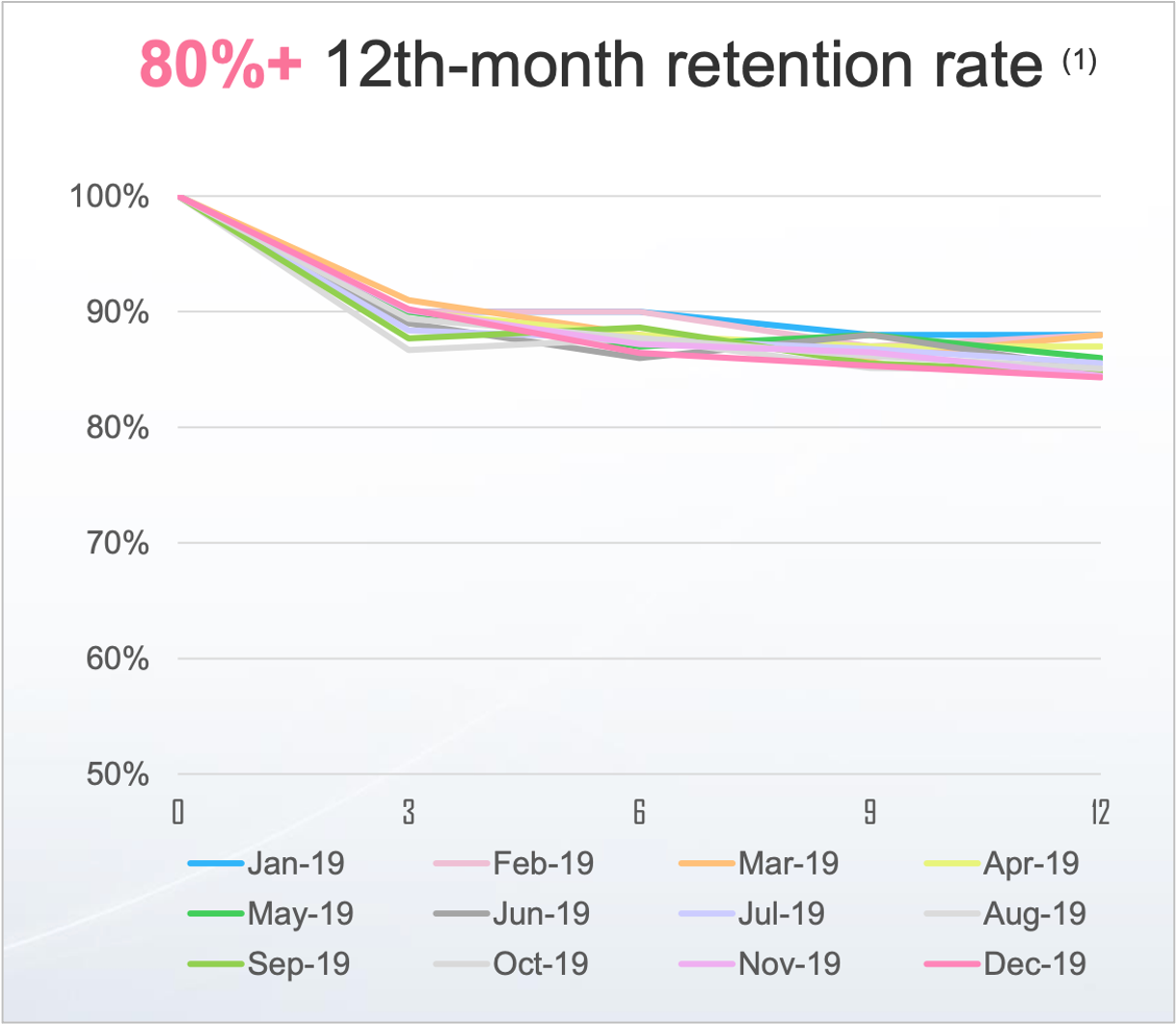
What’s most unique about Bilibili is how engaged and retentive its communities are. Bilibili achieves this by building friction into community. In order to join a Bilibili community, users must pass a 100-question test. A sample question from the quiz to join the Game of Thrones community, according to Lillian Lin: “Which of the following is not part of the Faith of Seven?” (For what it’s worth, I watched all eight seasons and there’s zero chance I could answer that question.) Bilibili used to require an 80% correct score to enter the community, though it’s become more lenient over time. Building in friction means that communities are comprised only of superfans; 80%+ of users retain after 12 months.
a.image2.image-link.image2-1062-728 {
display: inline;
padding-bottom: 145.87912087912088%;
padding-bottom: min(145.87912087912088%, 1062px);
width: 100%;
height: 0;
}
a.image2.image-link.image2-1062-728 img {
max-width: 728px;
max-height: 1062px;
}
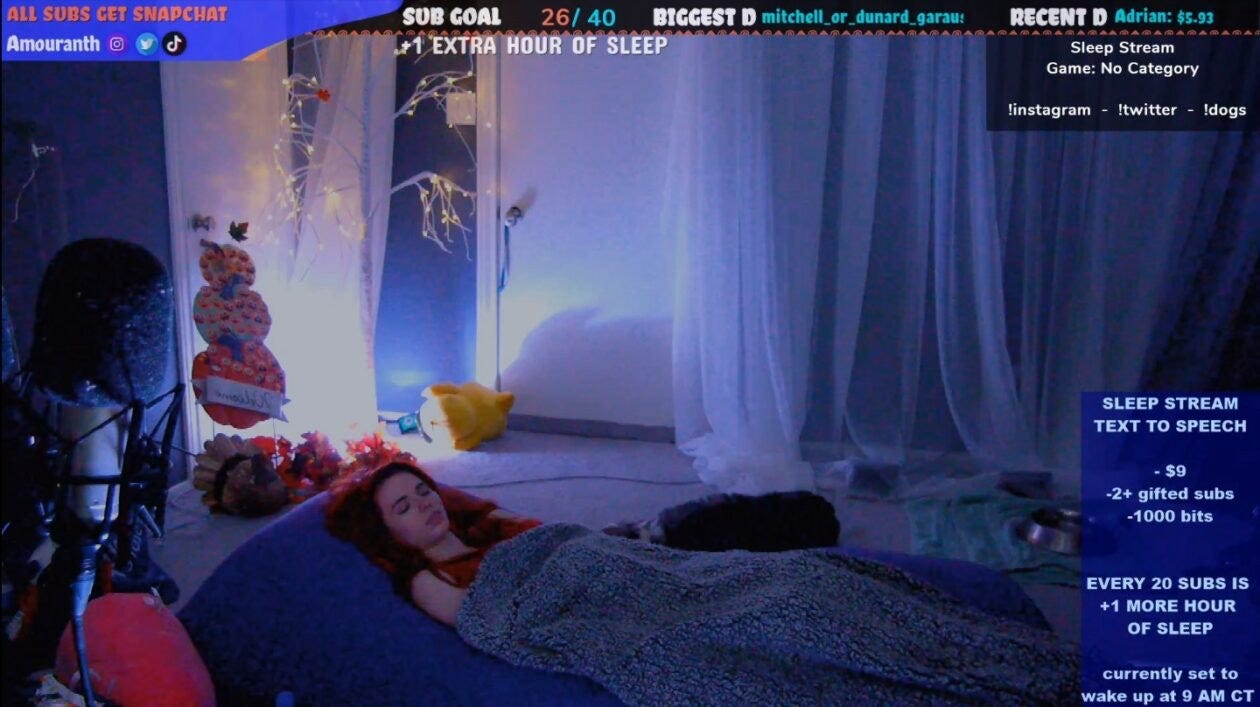
The search for online belonging manifests in many ways: the casual livestreaming category “Just Chatting” becoming Twitch’s fastest-growing category; the rise of creator fandoms; even the phenomenon of sleep streaming—watching other people sleep over livestream.
If the 2010s were the decade of performance online—status and signaling in broad brushstrokes, through likes and retweets and follower counts—the 2020s are the decade of deep and engaged digital communities.
📹 Authenticity
Last month, Zoolander celebrated its 20th anniversary. Back in 2001, Ben Stiller’s brainchild (Stiller also directed the film) was a massive flop—critics panned it as a “one-joke movie” and it was a box office failure. But it’s since become a cult phenomenon, perhaps most famous for Derek Zoolander’s “Blue Steel” pose:
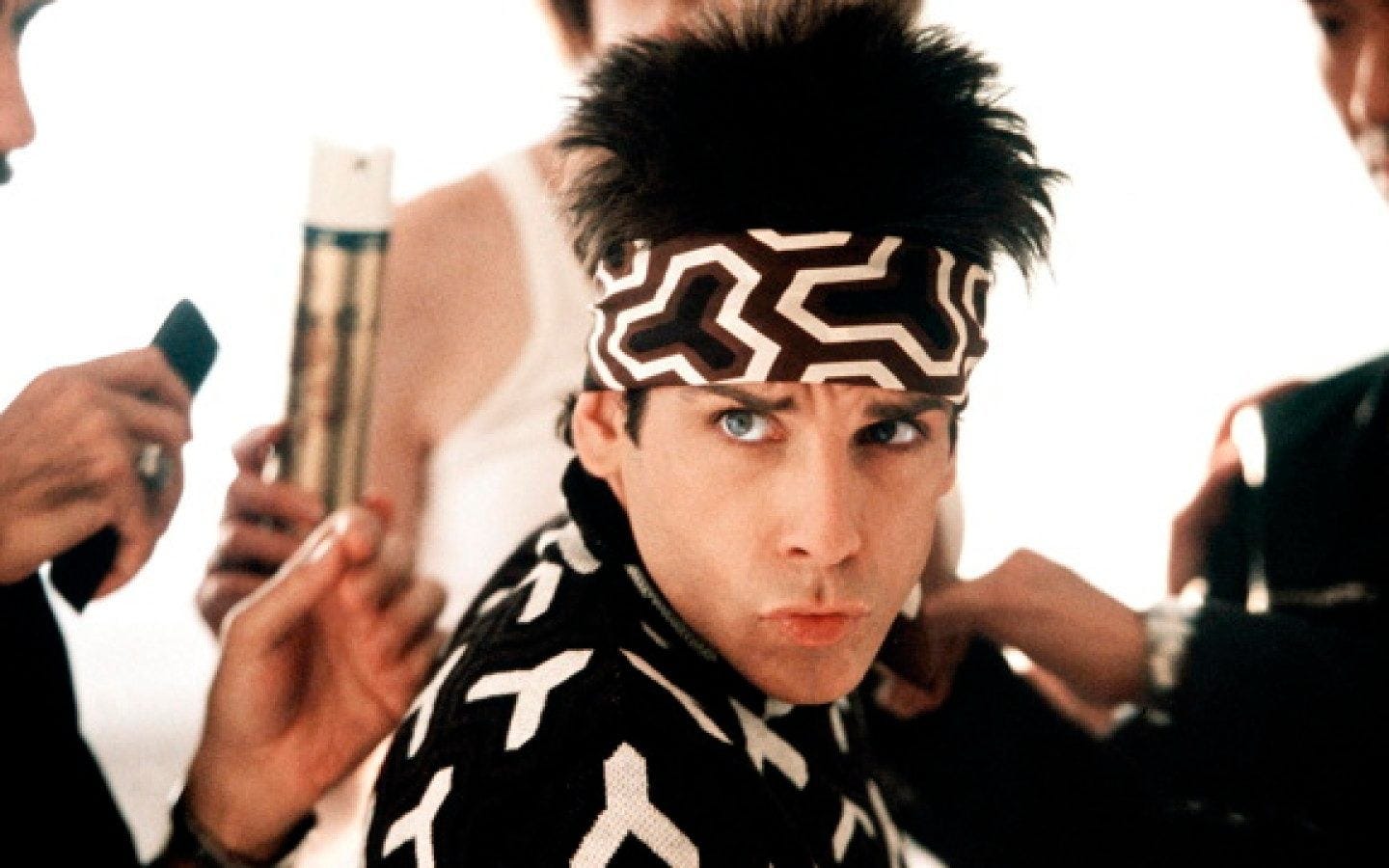
In some ways, Zoolander foreshadowed our self-obsessed social media culture. John Hamburg, the film’s writer, says, “It kind of predated social media, obviously, but I think it tapped into these things that were brewing and would explode with the Kardashians.”
Ilana Kaplan at Esquire put it best:
The film held a magnifying glass to a culture that was consumed by narcissism and an obsession with appearances…And as for “Blue Steel,” “Le Tigre” and “Magnum”? They’re all different versions of “duck face.” In 2021, whether we’d like to admit it or not, we’re all just Derek and Hansel—but with better lighting.

a.image2.image-link.image2-450-706 {
display: inline;
padding-bottom: 63.6%;
padding-bottom: min(63.6%, 449.016px);
width: 100%;
height: 0;
}
a.image2.image-link.image2-450-706 img {
max-width: 706px;
max-height: 449.016px;
}
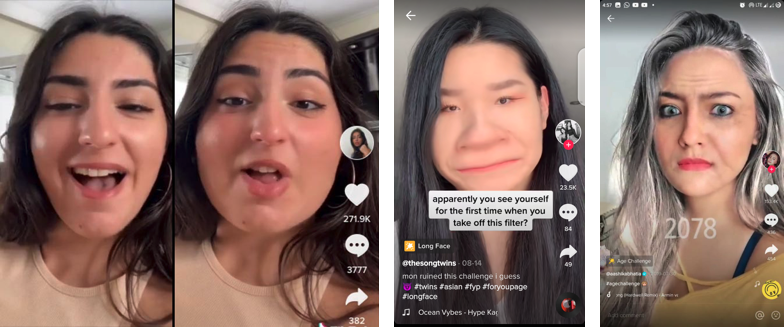
“Authenticity” has become an overused word—especially when tied to Gen Z—but it also captures a collective exhaustion with the narcissistic, image-obsessed internet culture of the past decade. This year’s social media upstarts have leaned into authenticity. I wrote about three of them in June’s The Evolution of Social Media: BeReal, Dispo, and Poparazzi. In many ways, they’re taking on Instagram, which began as a literal filtered version of reality. (A side note: while Instagram’s filters were meant to beautify your images, many filters on Snapchat and TikTok purposefully make you look less attractive. It’s a fascinating distinction in how the products were designed and, consequently, in the types of users they attract.)
a.image2.image-link.image2-327-728 {
display: inline;
padding-bottom: 44.917582417582416%;
padding-bottom: min(44.917582417582416%, 327px);
width: 100%;
height: 0;
}
a.image2.image-link.image2-327-728 img {
max-width: 728px;
max-height: 327px;
}
Authenticity shows up in the types of platforms we’re spending time on. More “authentic” platforms like Snapchat and TikTok continue to thrive.
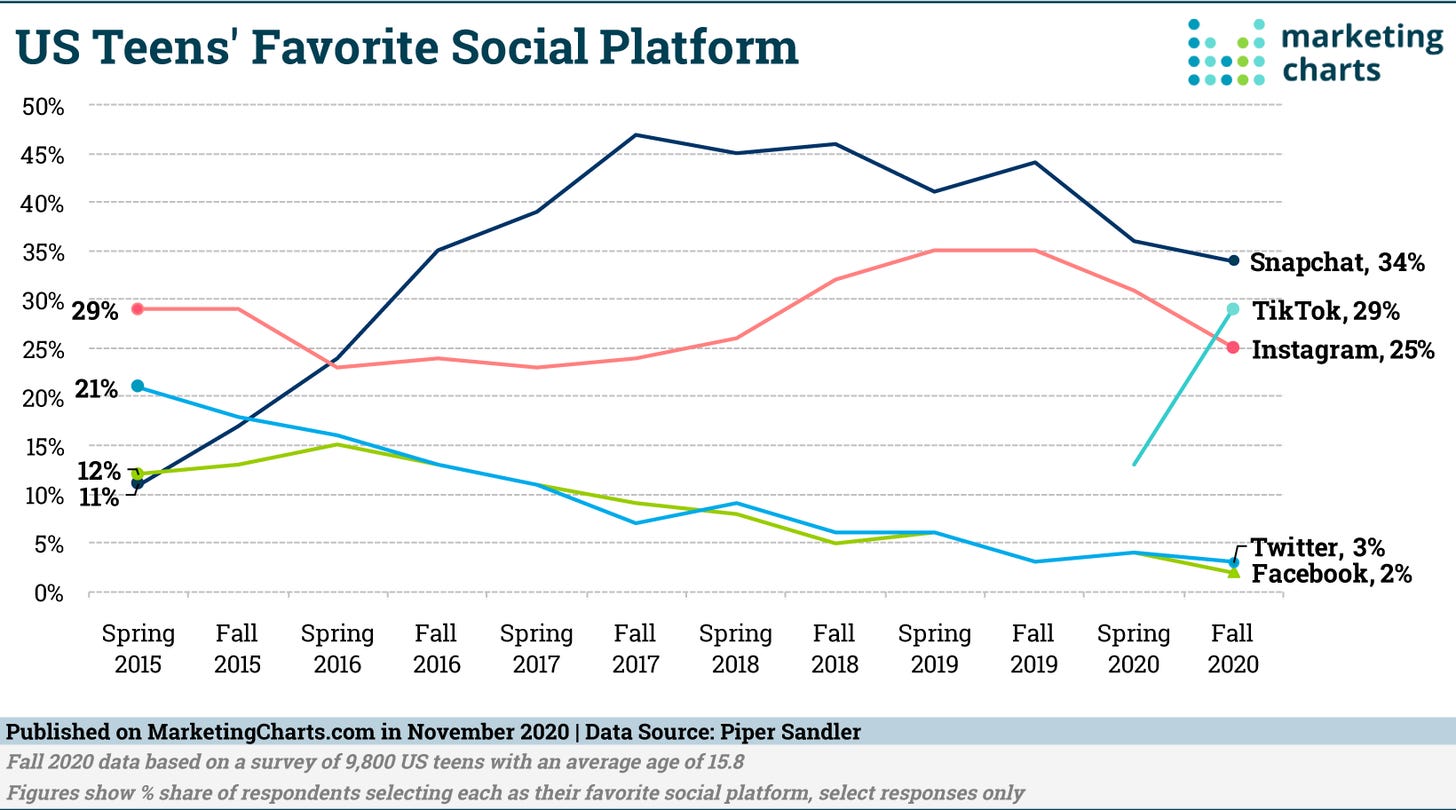
More 13- to 34-year-olds in the U.S. are on Snapchat than are on Instagram or TikTok. Evan Spiegel’s strategy is to 1) keep younger users as they age, and 2) attract new cohorts of young users. It seems to be working.

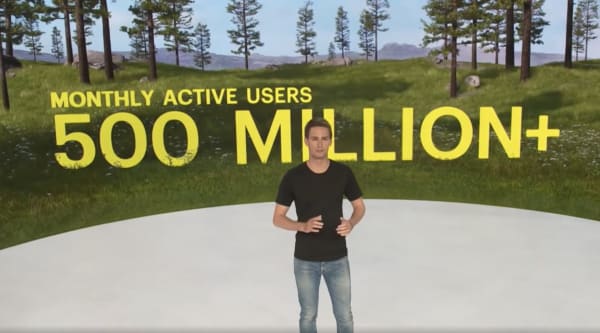
Facebook and Instagram use are down; iMessage and TikTok use are up. Mark Zuckerberg emphasized this in Facebook’s earnings release last month:
Facebook Chief Executive Mark Zuckerberg, on an analysts call, also addressed Facebook’s growing competition for young adult users from Apple’s iMessage app and the rise of ByteDance’s TikTok, saying that retaining and adding members of this demographic segment is essential for the company’s long-term success.
What’s interesting is that iMessage and TikTok are polar opposites: iMessage is where you connect with your closest contacts, and TikTok is where you connect with strangers. Facebook’s suite of products falls into the wasteland of “loose social ties” in the middle. Zuckerberg is being attacked from both sides.
I often use a framework of concentric circles for the future of social:
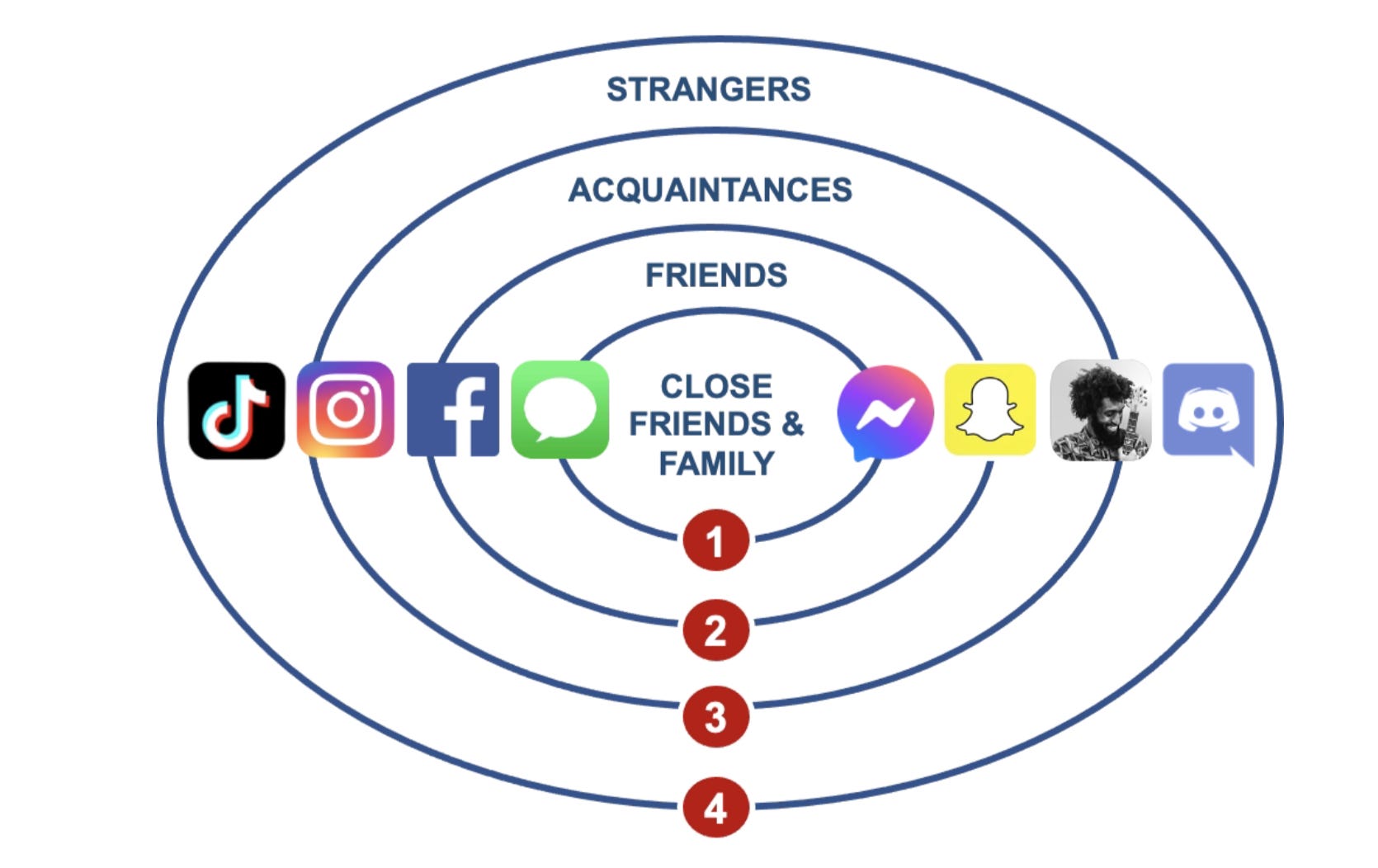
Ring 1 and Ring 4 are the future.
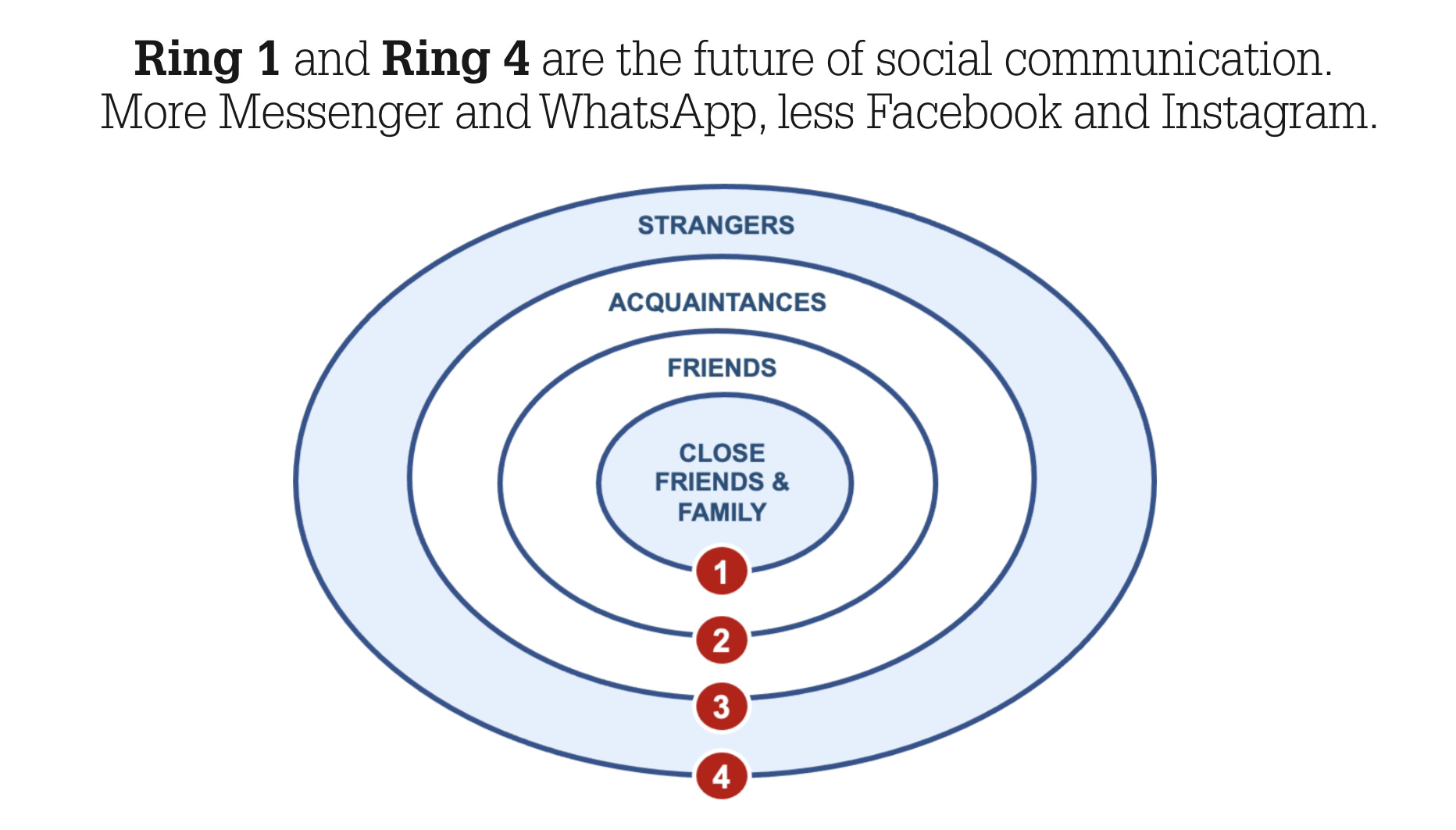
And as we shift to more Ring 1 and Ring 4 platforms, we emphasize authenticity over aspiration.
👽 Avatars
Authenticity brings us to avatars. This might seem a strange connection: aren’t avatars, by nature, inauthentic? After all, avatars entail being someone other than yourself. But for many people, avatars are a vessel for more authentic self-expression.
This shows up in the root of the word: the word “avatar” originates from Hinduism, where it stands for the “descent” of a deity into terrestrial form. In 1985, the video game developer Richard Garriott used the word to refer to his player in a video game—Garriott wanted his player’s character to be his Earth self manifested into the virtual world—and the word caught on. Avatars have evolved into digital representations of who we are or who we hope to be.
The vTuber (virtual YouTuber) Ironmouse is a creator who streams in the form of a pink-haired anime girl. Here she is being interviewed by Anthony Padilla:

Ironmouse became a vTuber because of an autoimmune disorder—Common Variable Immune Deficiency, or CVID—that limited her offline life. She remembers: “I got so sick that I couldn’t go out. My contact with people was very limited and I felt that I couldn’t really be a human. So I started being a vTuber.” Ironmouse found community online and, crucially, was able to express herself in a body she felt comfortable in: she says, “I have never felt more myself than I have in this digital body.”
Equally fascinating is Sam Kelly, a man who spends hours in a virtual world called Stardew Valley. Sam writes:
“In the real world, I am a burly 27-year-old man with a bushy beard. In the video game, I am Olivianne, a strapping blue-haired woman married to Penny.”

Sam’s avatar allows him to be a lesbian with two children who raises livestock. This unlocks a new side of him: a self-proclaimed introvert in the real-world, Sam is “a social butterfly” in Stardew Valley.
We’re seeing more creators lean in to digital self-expression. I’ve written extensively about Miko, who I also had the chance to interview during the Index Creator Summit. “The Technician” leverages the Unreal Engine and her mo-cap suit to embody Miko.
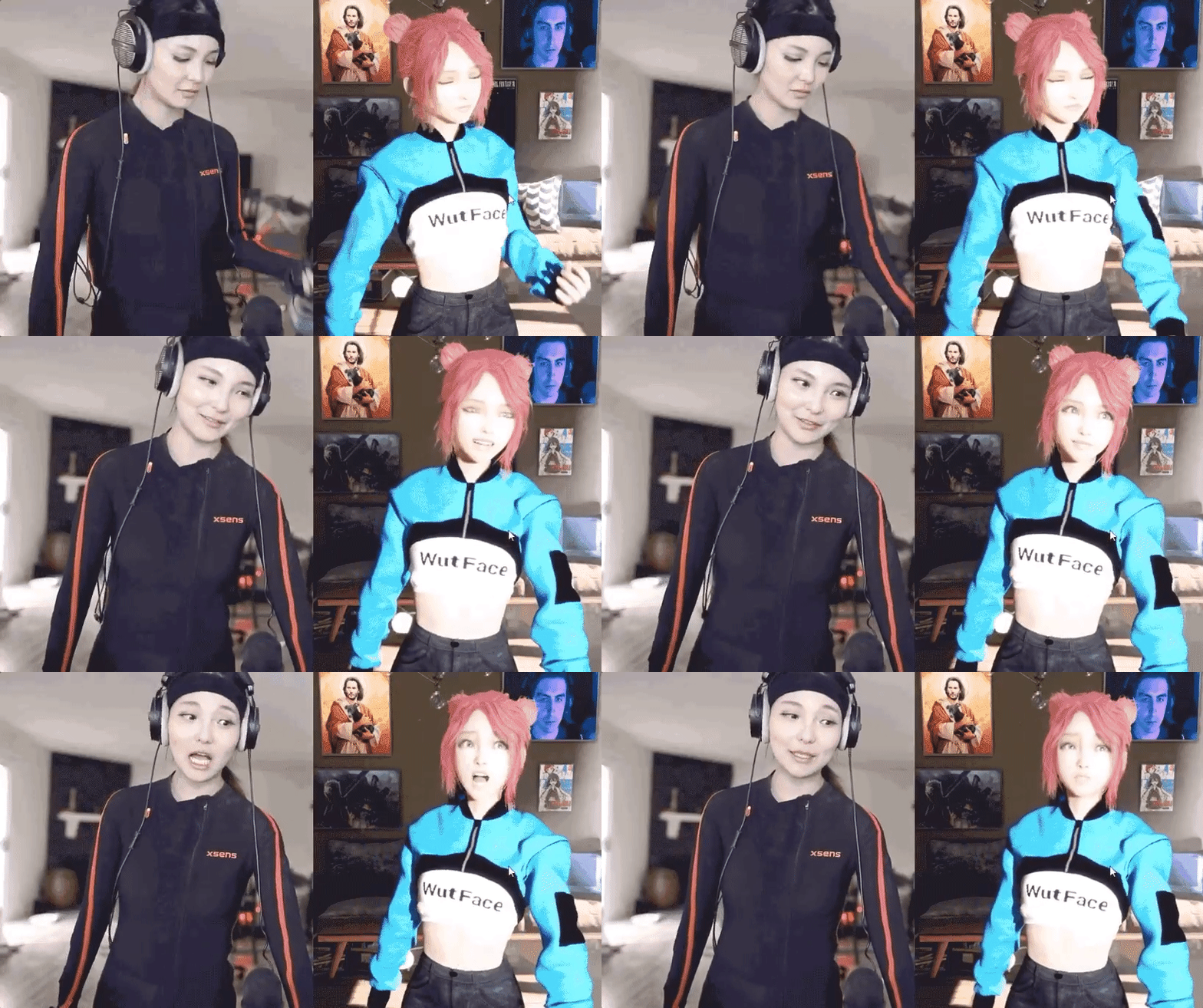
When I think of avatars, I often think of a quote from Ready Player One. Asked why people visit the OASIS—a vast, immersive virtual world—the protagonist says: “People come to the OASIS for all the things they can do, but they stay because of all the things they can be.” People stay for who they can be.
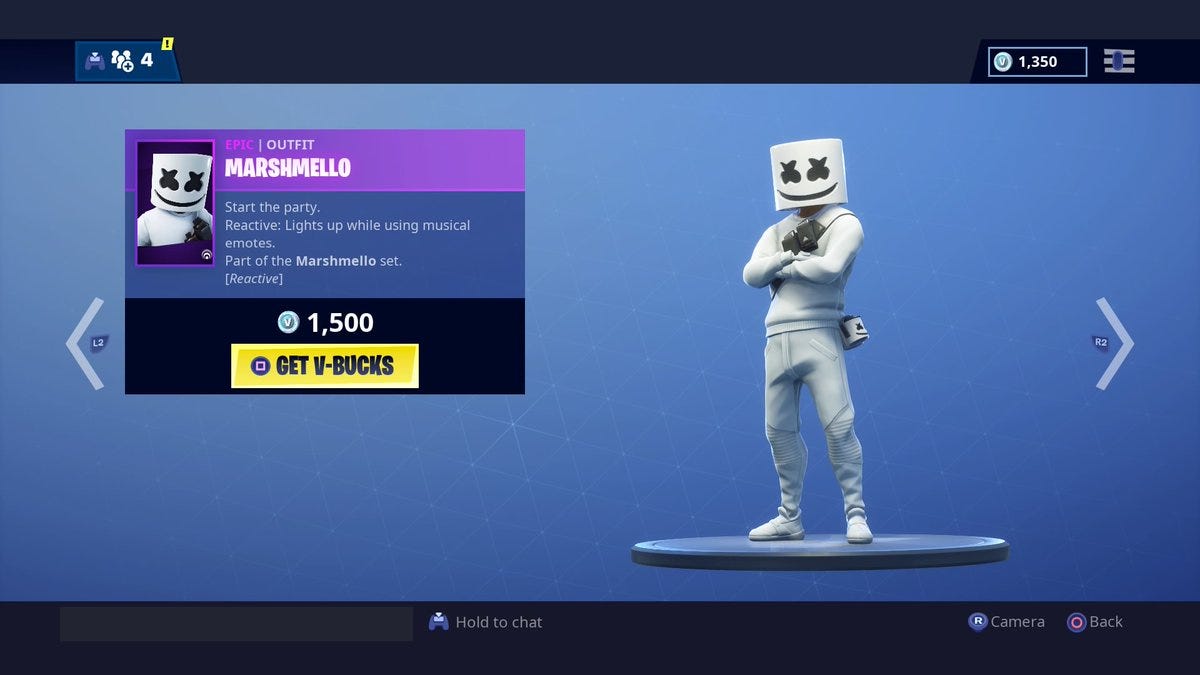
Within worlds like Minecraft and Roblox and Fortnite, people are already embodying new digital identities. In Fortnite, you can pay ~1,500 V-Bucks (~$15) to be Iron Man or a Patriots player or Marshmello.
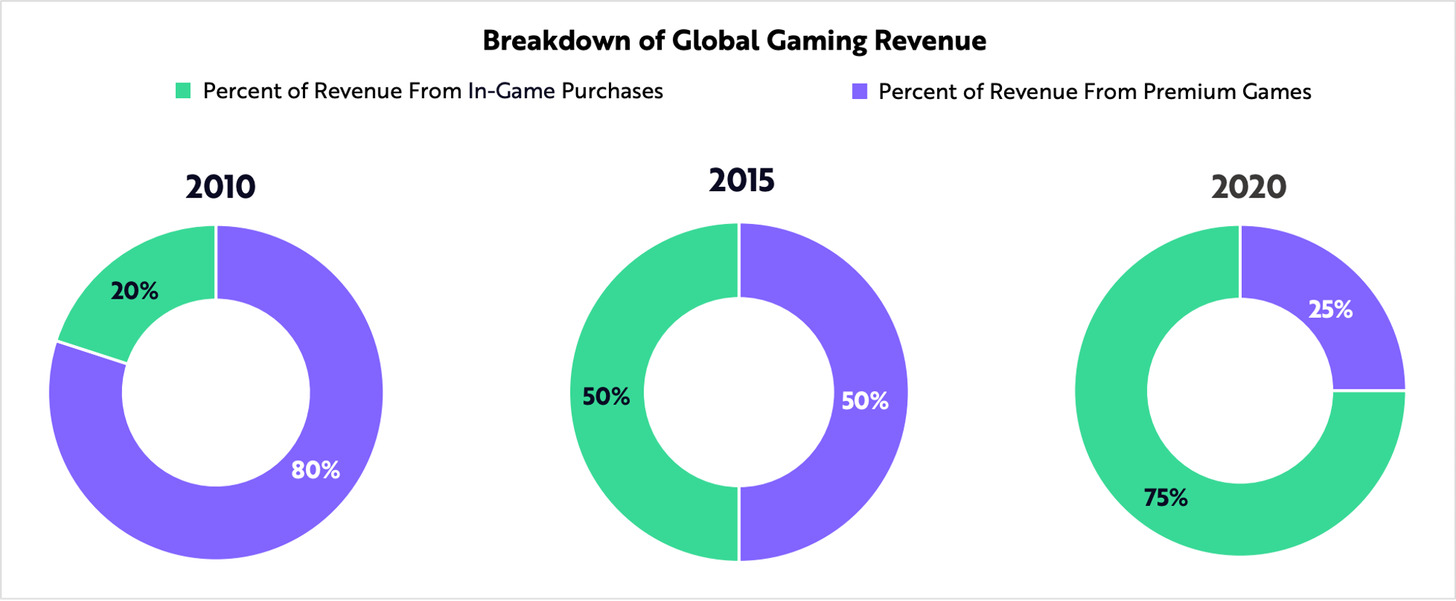
Outfitting our avatars in virtual worlds has become a massive business: a decade ago, microtransactions made up 20% of gaming revenue; today, they make up 75%. By 2025, they’re expected to grow to 95%.
a.image2.image-link.image2-601-728 {
display: inline;
padding-bottom: 82.55494505494505%;
padding-bottom: min(82.55494505494505%, 601px);
width: 100%;
height: 0;
}
a.image2.image-link.image2-601-728 img {
max-width: 728px;
max-height: 601px;
}
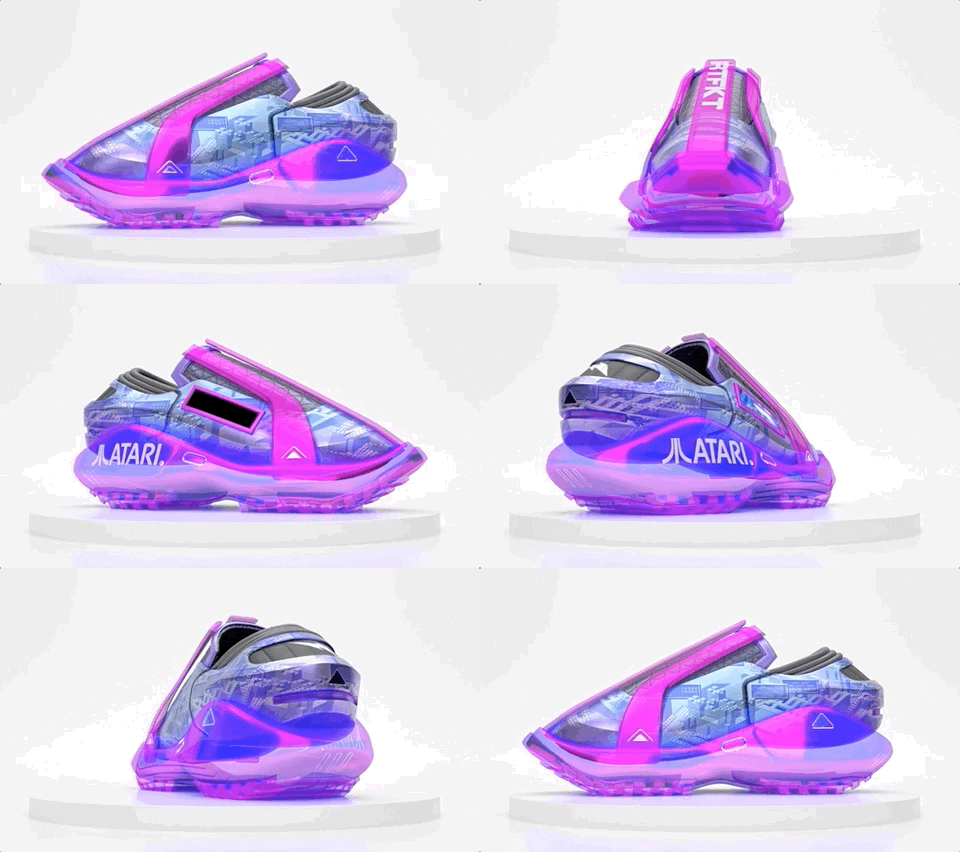
But our digital items exist within walled gardens: your Fortnite skin doesn’t work in Roblox. New companies are bringing avatars to life in new ways, often by building interoperability into digital assets. RTFKT, for instance, is a digital fashion house that sells NFT sneakers. You can envision one day wearing these sneakers between virtual worlds.
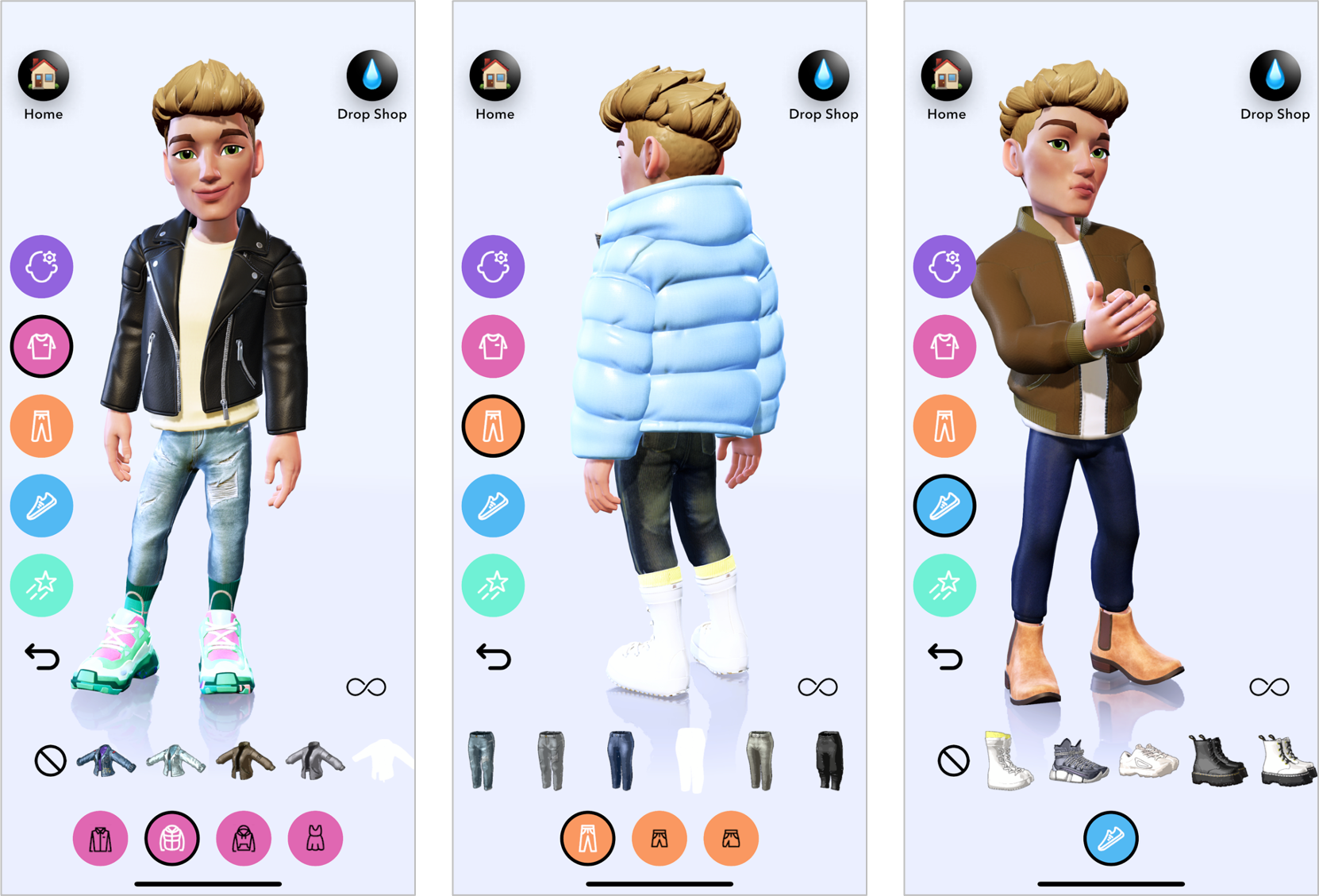
Genies allows anyone to design their own avatar and then buy digital clothing and accessories. Here’s my Genie—in the photo on the right, I’m doing my best Zoolander Blue Steel impression.
And Ready Player Me is a cross-game avatar platform. Game developers can quickly integrate avatars into their game, while players can snap a selfie (which generates their avatar) and then use that avatar in 660 supported games.
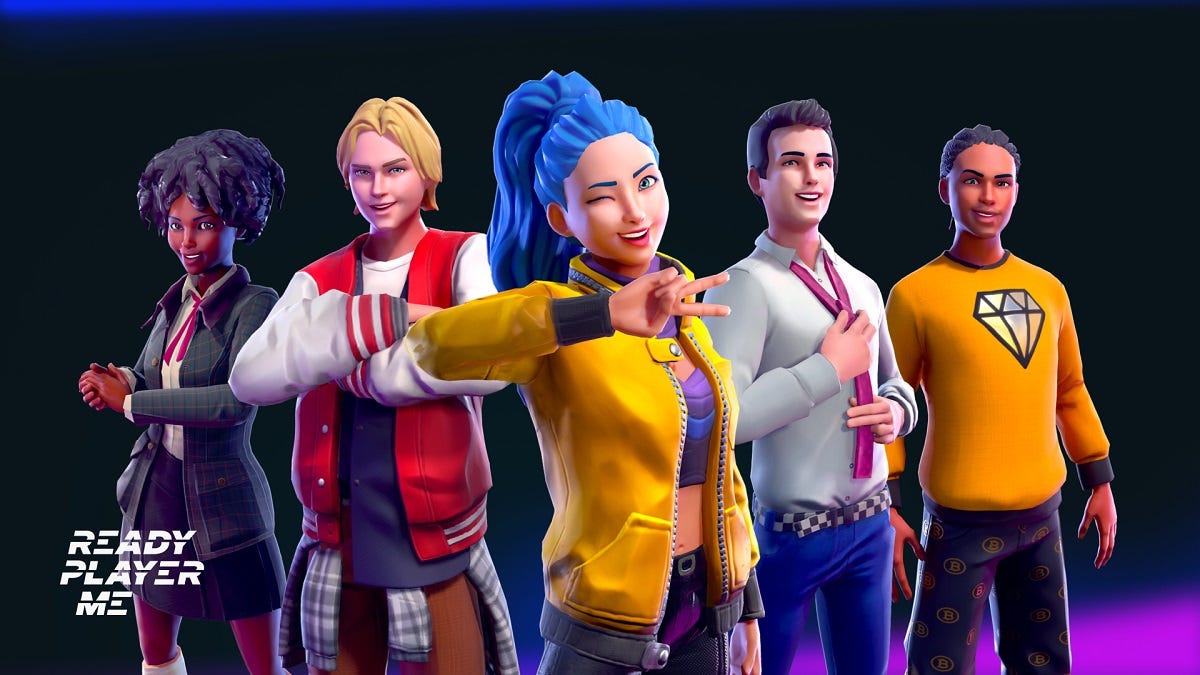
Fittingly, Ready Player Me calls itself “Your passport to the metaverse.”
🪐 Metaverse
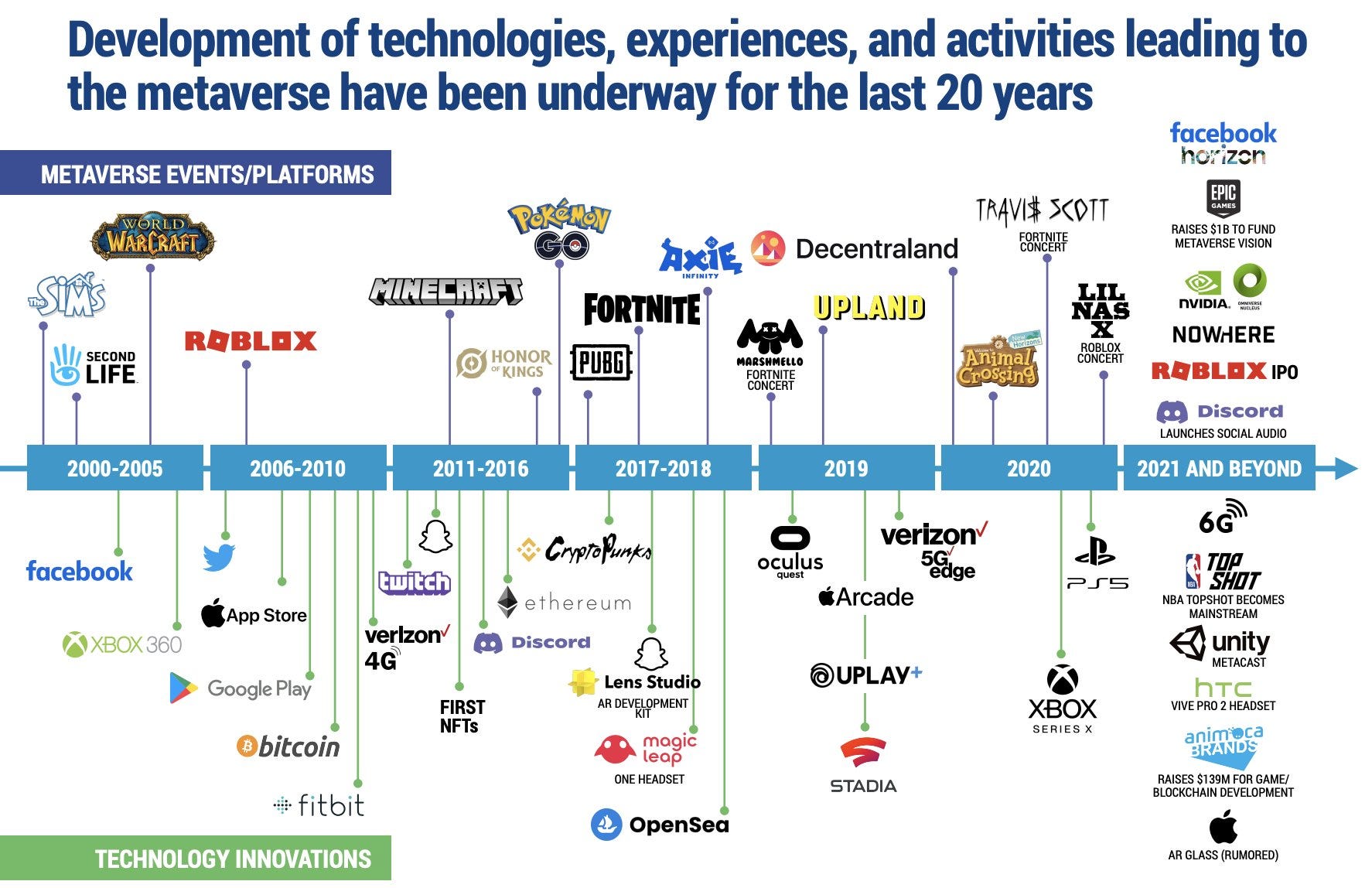
The metaverse is perhaps the buzzword of 2021, but there’s been a long road leading up to this point:
a.image2.image-link.image2-425-656 {
display: inline;
padding-bottom: 64.6978021978022%;
padding-bottom: min(64.6978021978022%, 424.4175824175824px);
width: 100%;
height: 0;
}
a.image2.image-link.image2-425-656 img {
max-width: 656px;
max-height: 424.4175824175824px;
}
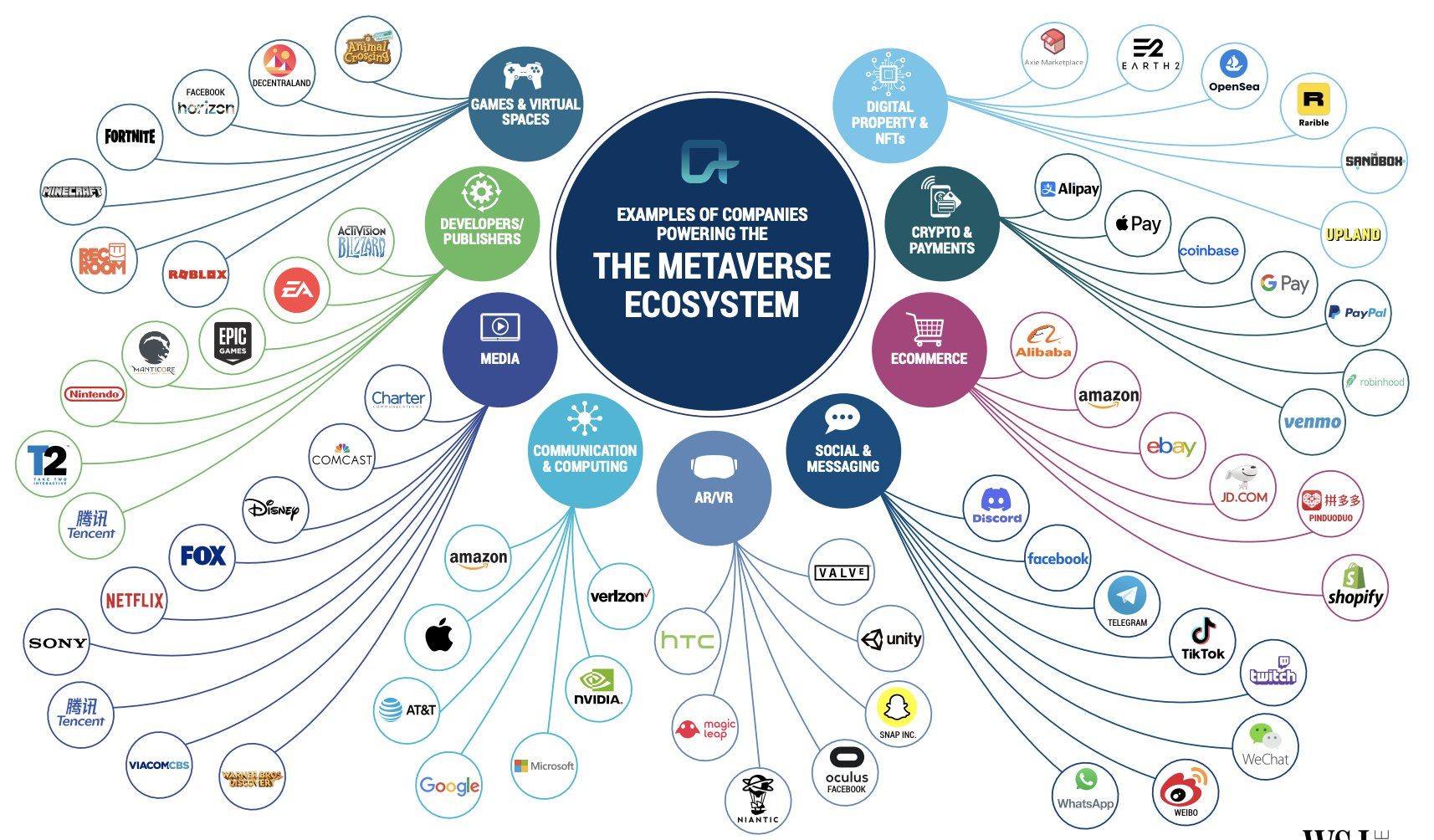
We’ve been building toward this future for years; as I wrote about in July, even Neopets helped paved the way. And as the below graphic helpfully captures, “the metaverse” has many components: gaming, media, messaging, commerce, crypto. Of course, these aren’t metaverse companies themselves—but they’re building a digital future that will accelerate our road to the metaverse.
a.image2.image-link.image2-395-674 {
display: inline;
padding-bottom: 58.58516483516484%;
padding-bottom: min(58.58516483516484%, 394.864010989011px);
width: 100%;
height: 0;
}
a.image2.image-link.image2-395-674 img {
max-width: 674px;
max-height: 394.864010989011px;
}
In perhaps the biggest sign yet that the metaverse is now mainstream, Vanity Fair published a piece last month called The Metaverse Is About to Change Everything. My favorite part of the piece is when Nick Bilton envisions what this future could look like:
The number of possibilities around the metaverse are endless, but you can easily imagine how it might change the way we interact in the same way that mobile devices have changed society today. In a world where the metaverse exists, rather than hosting a weekly meeting on Zoom with all of your coworkers, you could imagine meeting in a physical representation of your office, where each person looks like a digital version of themselves, seated at a digital coffee table drinking digital artisanal coffee and snacking on digital donuts. If that sounds a bit boring, you could meet somewhere else, perhaps in the past, like in 1776 New York City, or in the future, on a spaceship, or at the zoo, on another planet—if it made sense for the meeting, of course. You could choose not to be yourself, but rather some form of digital avatar you picked up at the local online NFT swap meet, or at a virtual Balenciaga store. You could dress like a bunny rabbit to go to the meeting. A dragon. A dead dragon. And that’s just one measly little meeting. Imagine what the rest of the metaverse might look like.
You could play first-person shooter video games in the metaverse, that look like they’re in real life. You could take a British history class taught by a digital representation of King George III, or learn about the theory of relativity from Albert Einstein himself. You could attend a TED Talk, or give one, or go to church. You could hook up your exercise bike to race against Maurice Garin in the Tour de France. Or your running machine to race against Usain Bolt at the Olympics (and lose). You could go to the zoo. You could be an animal at the zoo. Visit the Louvre. Le Mans. The International Space Station. You could go for a walk on Mars. Neptune. Float in space. Play “red light, green light” with your friends in Squid Game. You could go shopping, trying on outfits that once you pay for, are actually mailed to your house. You could go to a theme park and ride the world’s biggest roller coaster and maybe even throw up in real life. There are also lots of potential dark sides of the metaverse. Don’t be surprised to see Nazi rallies and people who choose racist and dangerous avatars, or hackers stealing from people, or performing metaversal terrorism, whatever that becomes. All of this stuff could be for sale in crypto, where we buy and sell digital goods with Bitcoin or Ethereum.
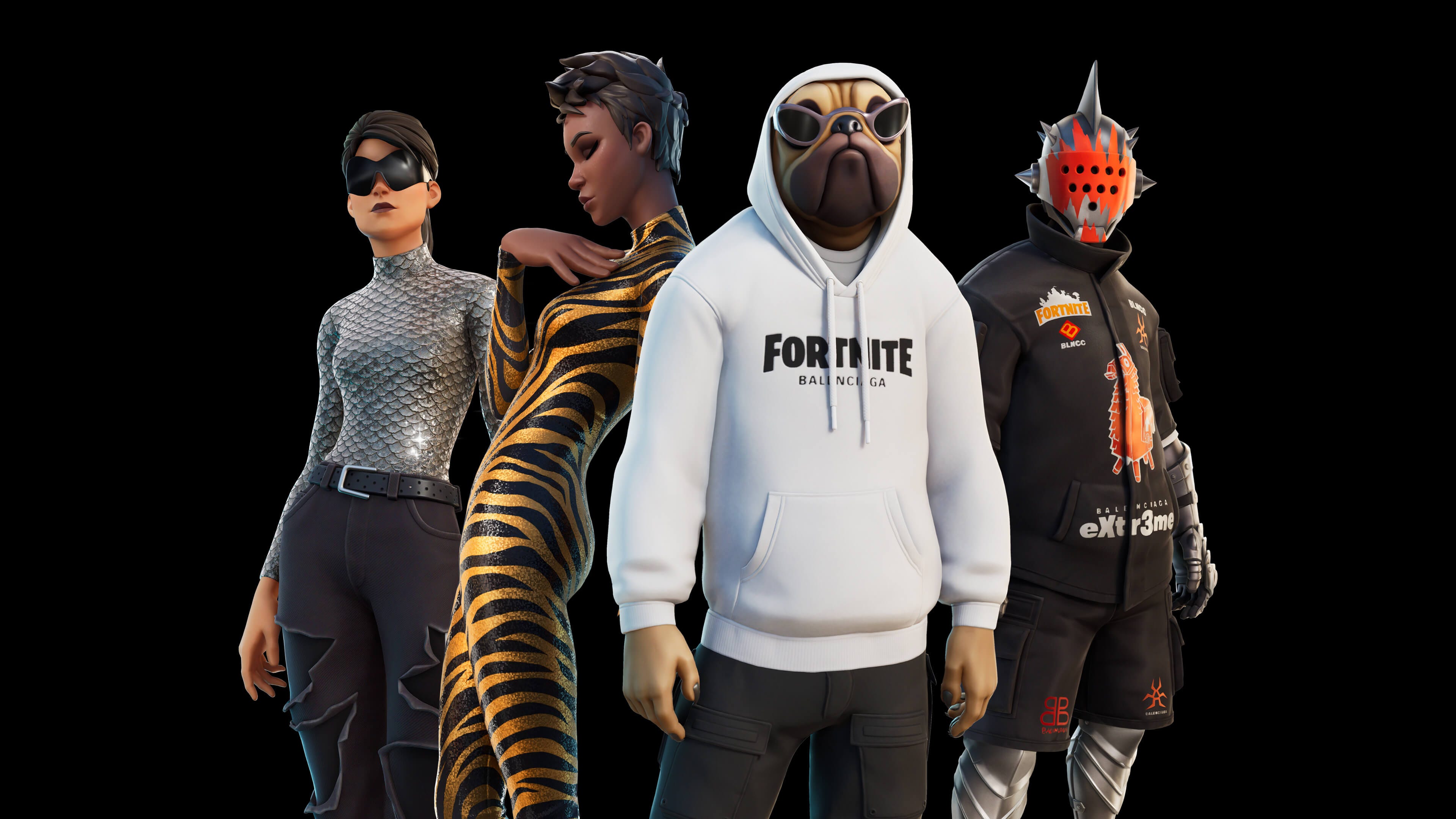
That’s a long excerpt, but it beautifully captures how grand this future could be. Some elements are already coming to fruition. That virtual Balenciaga store? It already exists in Fortnite:
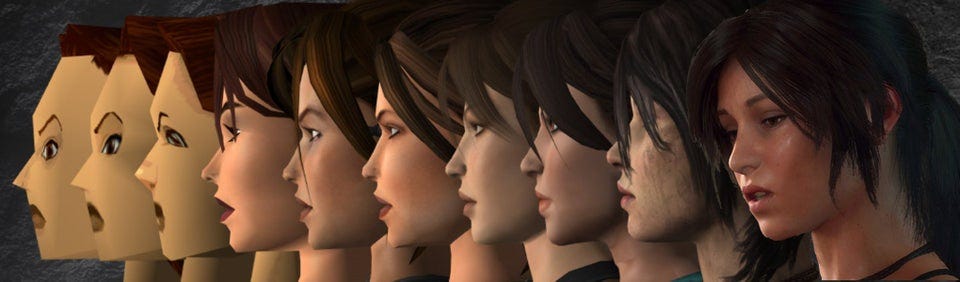
And if Bilton’s vision sounds far-off, remember how rapidly technology has progressed over the past 20 years. Here’s the progression of Lara Croft’s avatar from 1998 through 2018:
a.image2.image-link.image2-282-728 {
display: inline;
padding-bottom: 38.73626373626374%;
padding-bottom: min(38.73626373626374%, 282px);
width: 100%;
height: 0;
}
a.image2.image-link.image2-282-728 img {
max-width: 728px;
max-height: 282px;
}
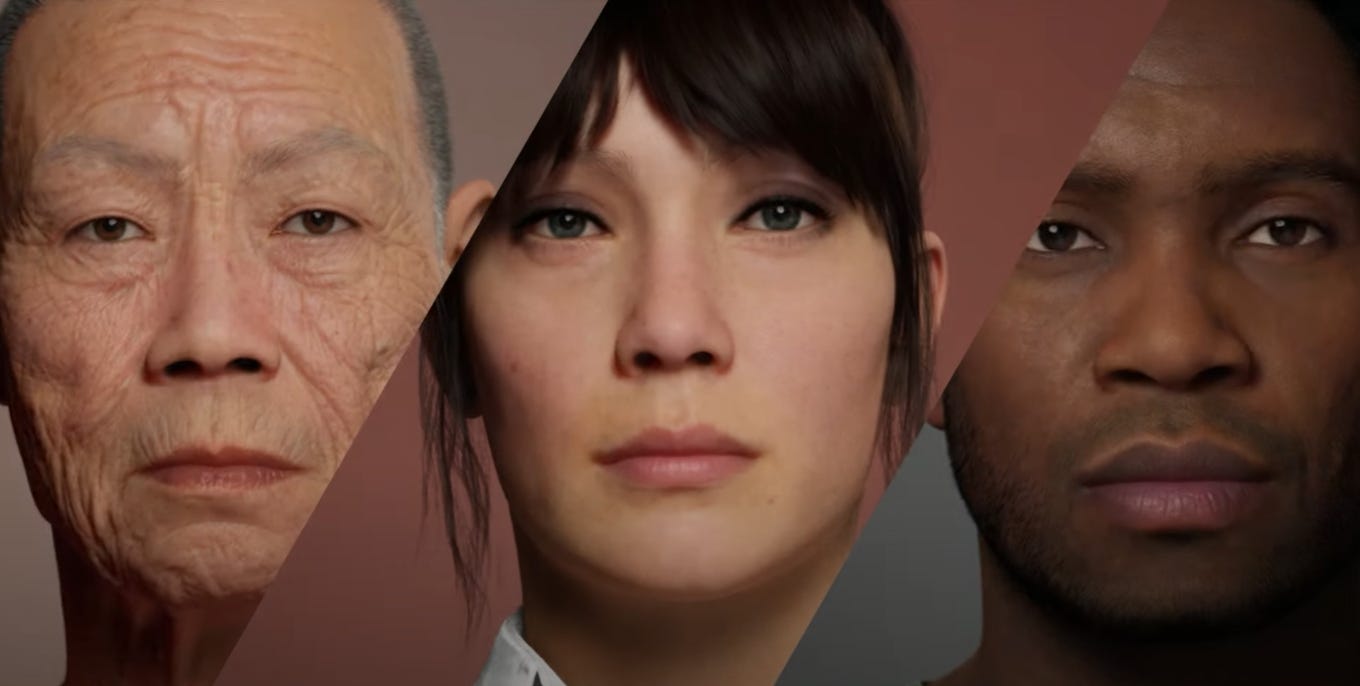
Technology is becoming more and more powerful, better forging digital worlds and digital identities that rival their analog counterparts. Unreal Engine, for instance, launched MetaHuman Creator as a tool for creating believable digital humans within minutes. Each of these faces was made by MetaHuman:
Or consider one of the most simultaneously fascinating and unnerving websites out there, ThisPersonDoesNotExist.com. Each time you refresh the website, a new human face is digitally rendered. Here are four such faces—none of these people exist:

a.image2.image-link.image2-532-526 {
display: inline;
padding-bottom: 100.96153846153845%;
padding-bottom: min(100.96153846153845%, 531.0576923076923px);
width: 100%;
height: 0;
}
a.image2.image-link.image2-532-526 img {
max-width: 526px;
max-height: 531.0576923076923px;
}
We’re hurtling towards our metaverse future. The full manifestation is still years (decades?) off, but the bricks are being laid. The next steps are VR and AR.
🔮 VR and AR
Virtual reality and augmented reality are the ultimate vessels for the metaverse. Our phones and computers and gaming consoles can act as portals, but VR and AR will deliver the metaverse in its truest form—vibrant, three-dimensional, immersive.
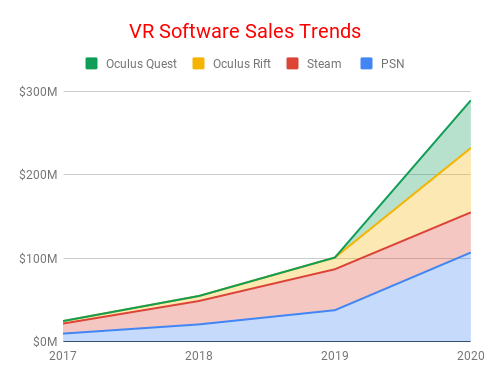
We’re still in the early days of VR and AR, but things are picking up. VR software sales inflected in 2019. By early 2020, over 100 VR titles had broken $1M in revenue. VR is finally moving from product to platform.
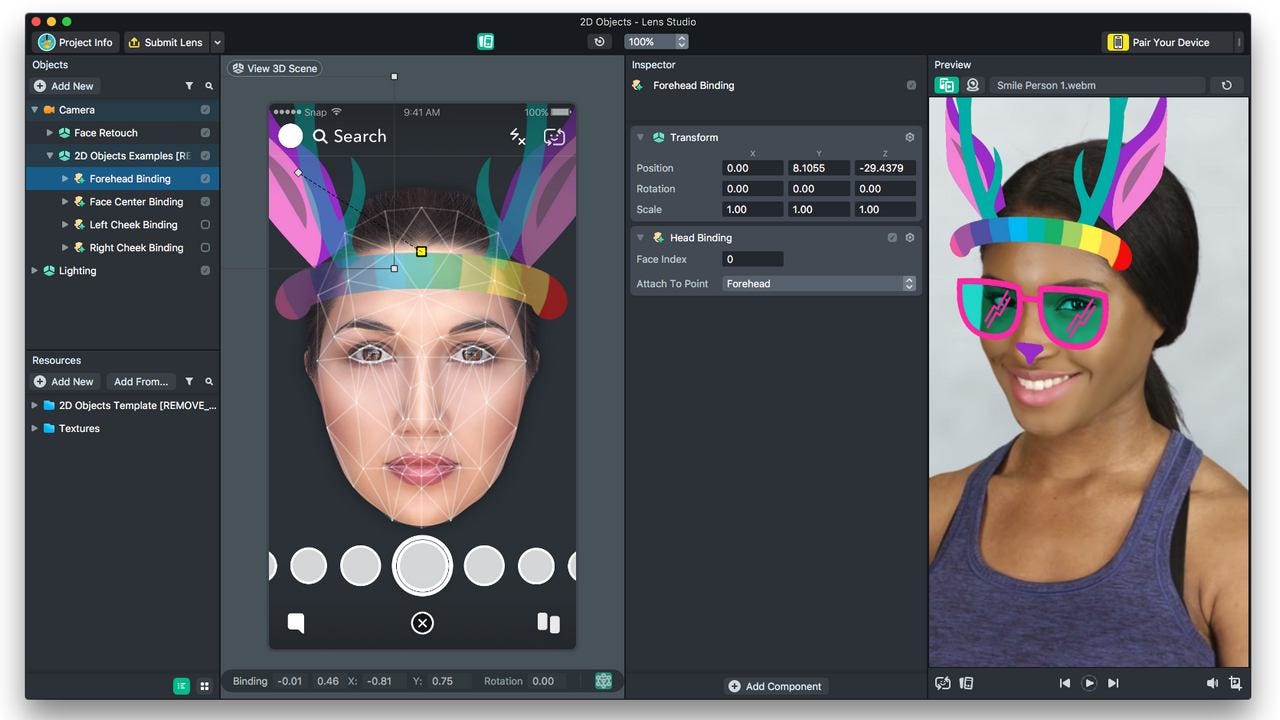
And on the AR side, Snap has been quietly building a robust platform of its own. Lens Studio lets developers build their own AR experiences with a set of accessible tools.

200 million Snapchat users interact with AR in the app every day, and “AR creator” is rapidly becoming a new job title.
Bilton envisioned our AR future in his Vanity Fair piece:
Maybe you come across as a three-headed puppy with multicolored pigtails to your kids, but a professional in a suit to your coworkers. In this scenario, you could play a game of Pac-Man in the real world, running around trying to capture virtual coins that no one else can see, or evading multicolored ghosts who want to eat you alive. You could sit in a coffee shop in New York while a friend sits in a coffee shop in Paris, and both have a “real” coffee together, even though you’re not in the same place.
Snap has been innovating on AR for years—its famous puppy-dog filter came out five years ago—but Snap is still criminally underrated for its efforts. Lens Studio and the creativity it unlocks will push forward AR, making it more accessible to both creators and end users. That’s one step closer to the realization of the metaverse.
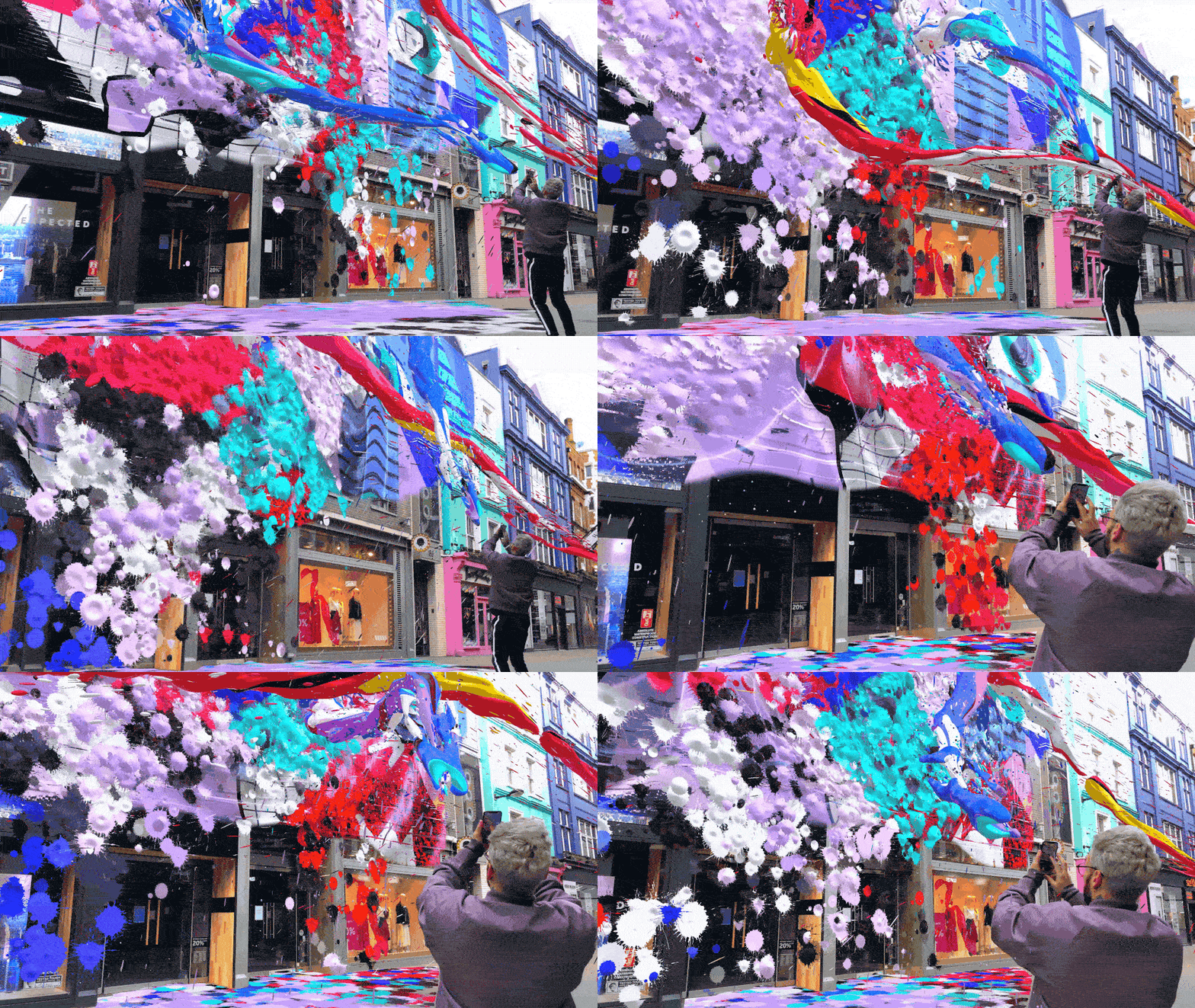
How Crypto Fits In
On a run in New York last week, while in town for NFT NYC, David Bowie’s “Changes” came on my playlist. As I ran along the Hudson, a few lines jumped out:
And these children that you spit on
As they try to change their worlds
Are immune to your consultations
They’re quite aware of what they’re goin’ through
Bowie’s song—one of his best—is about defying the status quo and stepping out to, well, change the world. To me, the lines captured much of the crypto movement.
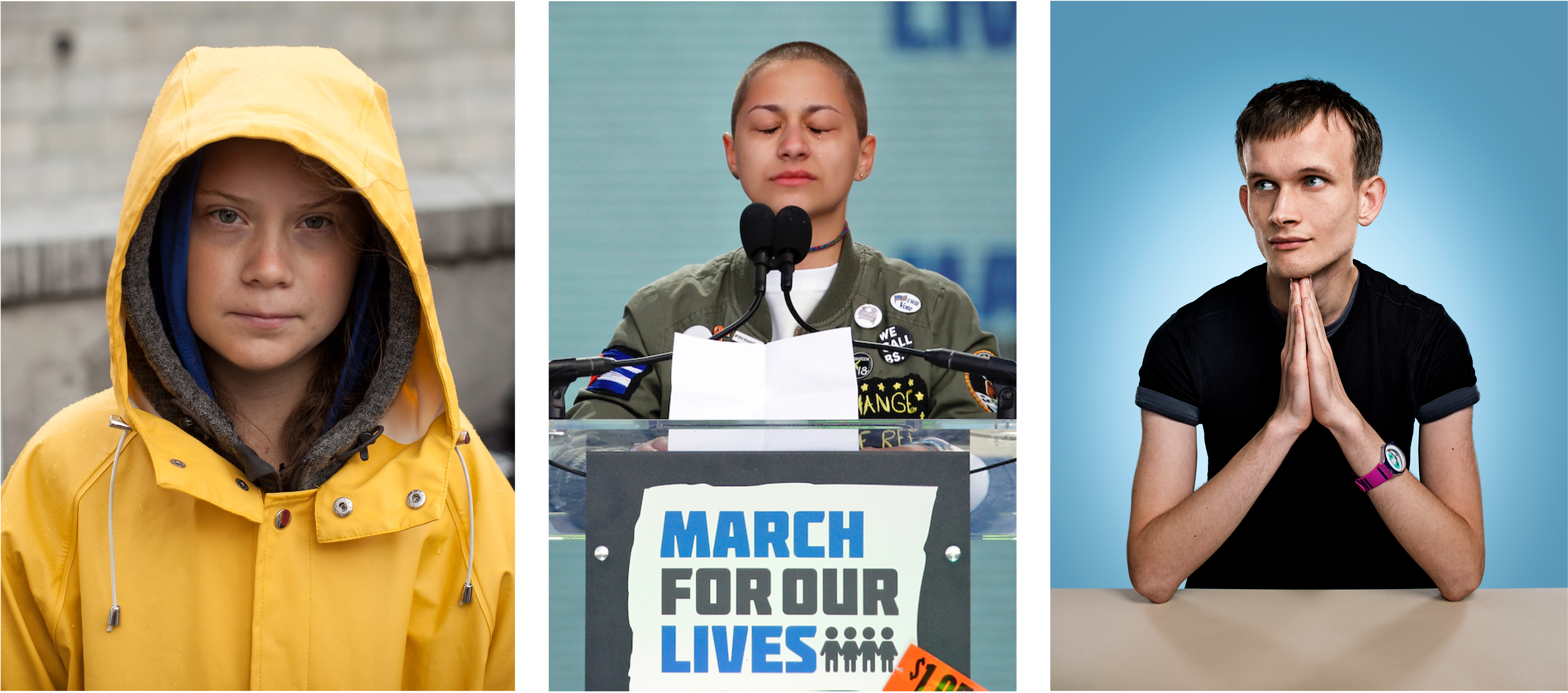
It’s easy to look down on crypto or to dismiss it, particularly given the market’s irrational exuberance. Skepticism often falls along generational lines: almost everyone I met at NFT NYC was young; almost everyone I know at OpenSea is between the ages of 25 and 30; and it’s not uncommon for crypto people to refer to all non-believers as “Boomers”. Change often comes from the young. Bowie’s lyrics apply as much to Greta Thunberg, as to X Gonzalez, as to Vitalik Buterin.
a.image2.image-link.image2-643-728 {
display: inline;
padding-bottom: 88.32417582417582%;
padding-bottom: min(88.32417582417582%, 643px);
width: 100%;
height: 0;
}
a.image2.image-link.image2-643-728 img {
max-width: 728px;
max-height: 643px;
}
This isn’t to say that a JPEG of a Clipart rock will still be worth $1.3 million in a few years. Many (most?) of today’s headline-grabbing NFT sales will end up worthless, just as many tech companies from the late 90s lost their value. But that doesn’t mean the movement itself is worthless.
<div class="tweet" data-attrs="{"url":"https://twitter.com/etherrockprice/status/1429908317015445509?ref_src=twsrc%5Etfw%7Ctwcamp%5Etweetembed%7Ctwterm%5E1429908946949742592%7Ctwgr%5E%7Ctwcon%5Es3_&ref_url=https%3A%2F%2Fau.finance.yahoo.com%2Fnews%2Frock-drawing-sells-18-million-meet-the-internets-newest-craze-210044498.html","full_text":"EtherRock 42 purchased for Ξ400 Ether\n($1,326,280.00)\n\n7 mins ago (Aug-23-2021 08:31:58 PM +UTC)\n\nTxn: etherscan.io/tx/0xd75711c69…\n\n#EtherRock #EtherRocks ","username":"etherrockprice","name":"EtherRock Price","date":"Mon Aug 23 20:48:03 +0000 2021","photos":[{"img_url":"https://pbs.substack.com/media/E9gOCRvVEA4vWXo.jpg","link_url":"https://t.co/UGWCfAu1zx","alt_text":null}],"quoted_tweet":{},"retweet_count":229,"like_count":1142,"expanded_url":{},"video_url":null}”>

EtherRock 42 purchased for Ξ400 Ether
($1,326,280.00)
7 mins ago (Aug-23-2021 08:31:58 PM +UTC)
Txn: etherscan.io/tx/0xd75711c69…
#EtherRock #EtherRocks







Leave a Reply