https://www.discovery-studios.com/
Join 35,000+ others who get my thoughts on product, tech, and creators — in as few words as possible, no more than twice a month.
Dear subscribers,
There’s never been a better time to build a new social network. Dan Romero is the co-founder of Farcaster, a “sufficiently decentralized social network” that’s quietly becoming the go-to platform for the most thoughtful conversations about crypto.
I’ve been using Farcaster for the past few months and it feels like the early days of Twitter when the community was more positive and tight-knit. In our interview below, I spoke to Dan about:
-
Why he started Farcaster
-
How Farcaster is scaling with quality in mind
-
Why developers should build on Farcaster
Starting Farcaster

Why did you decide to leave your VP role at Coinbase to start Farcaster?
I was at Coinbase from 2014 through 2019. When I joined, I was employee #20 but the company had grown to over 700 people by the time that I left. I wanted to try to start something from scratch again.
After I left, I spent some time traveling and got interested in the question: “Could you make RSS competitive with Twitter?”. That led me to explore this idea with a former Coinbase colleague of mine, Varun Srinivasan.
Tell me more about how this RSS idea led to the Farcaster protocol.
Well, let’s start by defining what a protocol is.
A protocol is a set of rules that let two entities communicate with each other.
Unlike a company, a protocol isn’t owned by any single entity. In other words, anyone can build on top of it.
If you look back to the web1 era, it was defined by protocols like HTTP (the web), SMTP (email), and RSS (content feed).
The web2 and mobile era, in contrast, has been controlled by closed, centralized networks. Paul Graham wrote a great post in 2009 about how Twitter is a protocol trapped within a company.
I started Farcaster to combine the protocol-based ethos of web1 with the great UX of web2.
Can you explain what Farcaster is?
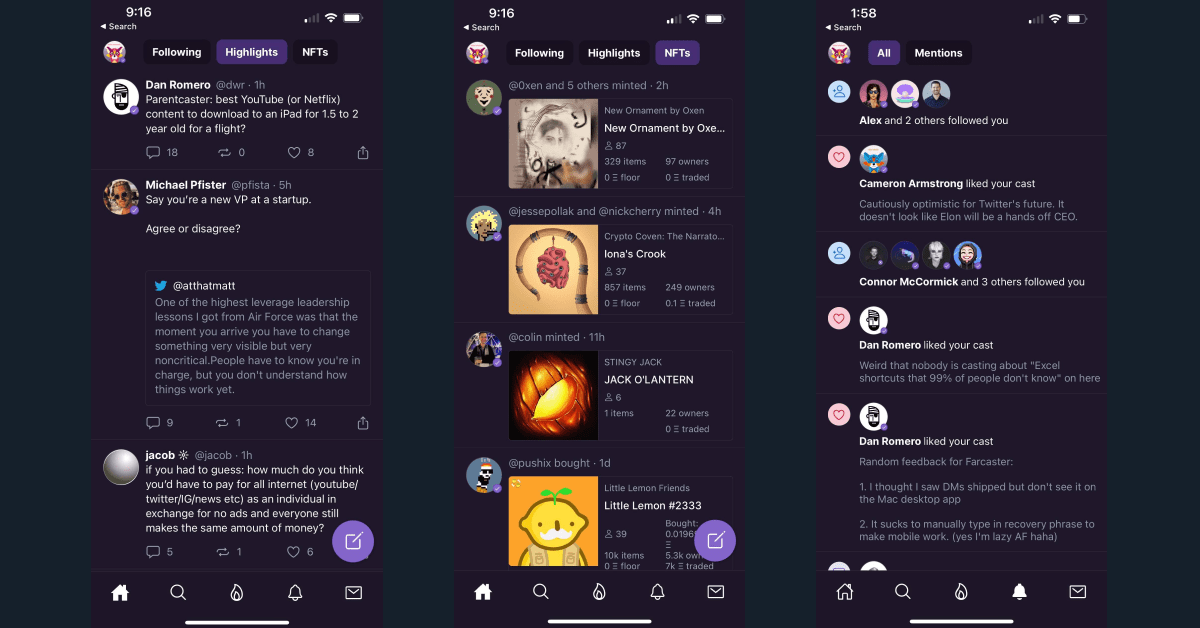
Farcaster is a sufficiently decentralized social network.
Compared to other web3 social protocols, Farcaster’s architecture is minimally on-chain. Only a user’s identity is on-chain; everything else—posts, likes, follows, profiles—are stored off-chain in specialized servers called Farcaster Hubs (similar to Ethereum nodes for the Ethereum network).
We did this to build the best of web2 and web3. We want Farcaster to have the usability and speed of a web2 app with the strong ownership guarantees and permissionless innovation of a web3 protocol.
To be clear, the Farcaster you’re using today is a single app on the protocol. My hope is that building a great app and a tight-knit community will attract more developers to build their own apps on the protocol.
How Farcaster is scaling with quality in mind
Web2 social networks already reach billions of users and have strong network effects. Why should a regular user care about moving to a web3 social network?
Regular users aren’t the target users for these networks right now.
Our focus is on early adopters — people who find it exciting to play around with new products and technologies and are willing to deal with the rough edges.
We believe that having these early creators will attract more developers to build new apps and services on the protocol. It’s at this point that you’ll likely see more normal users start to use the protocol (and in many cases, they might not even realize it).
That’s super interesting. So sounds like the GTM strategy is to:
-
Onboard quality creators to the Farcaster app
-
Attract more developers to build on the Farcaster protocol
-
Onboard regular users slowly
Yes, the value of social networks like Twitter and YouTube comes from creators who make great content and attract large audiences.
These creators are at the whim of centralized platforms – their audience which took a decade to build can disappear overnight.
With Farcaster, we are deliberately onboarding great creators slowly to keep the quality bar high.
How do you define what a quality user is?
It’s a bit hard to define “quality”—it’s more know when you see it type thing.
That being said, we’ve prioritized referrals from existing community members as the primary way to grow.
What I like best about Farcaster is that it’s familiar but also has a more tight-knit community. I almost don’t think about web3 stuff (e.g., decentralization) when using it. Is that by design?
Yes. We wanted to start with a familiar UX that would minimize the learning curve. And that ended up taking a lot of work. I have a lot of respect for all the product details an app like Twitter gets right when it comes to a text-based feed.
But once we had the basics taken care of, we started to expand the product surface area to include more crypto-native features.
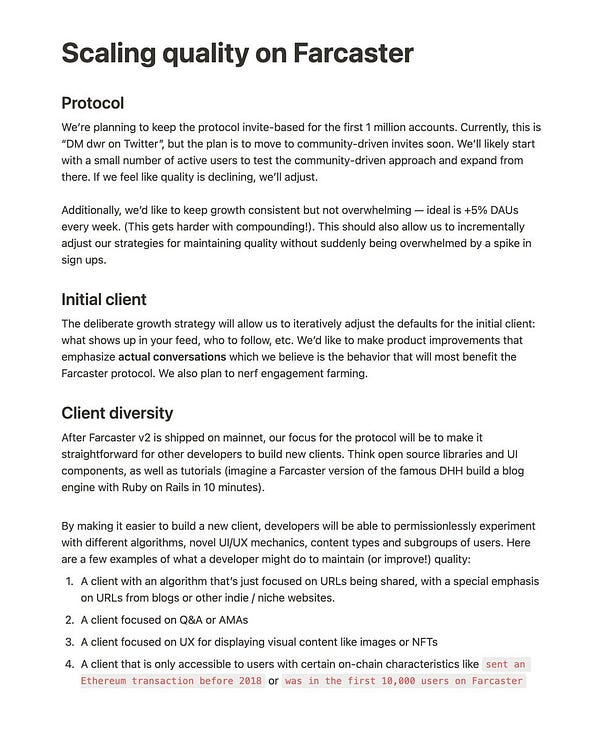
How do you think you can maintain this magic as Farcaster scales to more users? Will you have to introduce algorithms, spam filters, etc?
We’re focused on defaults and algorithms that reward conversations (vs. engagement).
Why developers should build on Farcaster
<div class="tweet" data-attrs="{"url":"https://twitter.com/sriramk/status/1573792719264063489","full_text":"The vibe around @farcaster_xyz and the growing number of apps being written on/people hacking on it feels a lot like the late 90s. \n\nopen source, Bittorrent, hacker spirit.","username":"sriramk","name":"Sriram Krishnan – sriramk.eth","date":"Sat Sep 24 21:53:18 +0000 2022","photos":[],"quoted_tweet":{},"retweet_count":9,"like_count":230,"expanded_url":{},"video_url":null,"belowTheFold":true}”>

open source, Bittorrent, hacker spirit.

 Global Discovery Blog
Leave a comment